Addressing compounding problems
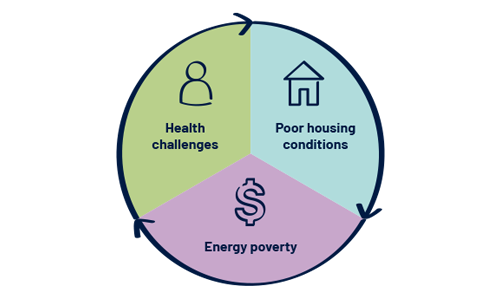
CSH addressed problems of poor health, poor housing conditions and energy‑related financial hardship.
In Australia, poor housing quality undermines health and makes it difficult for households to maintain safe indoor temperatures. This leaves many people with health conditions living in homes that are too cold in winter or too hot in summer.
Poor housing often has inadequate insulation and inefficient or unsafe heating and cooling systems. Because of unsafe indoor temperatures, many Australian households experience energy-related hardship. They may be forced to use too little energy (to save money at the expense of health), struggle to pay unaffordable bills, or cut other essential costs to afford energy. These issues often overlap with chronic illness or disability, which can reduce income and increase time spent in their too hot or too cold home.
For people with medical conditions, living without adequate heating or cooling can increase their risk of illness or death. Those most at risk include older people; young children; and individuals with chronic respiratory, cardiovascular, neurological, musculoskeletal or mental health conditions. These groups are over‑represented in low‑income households.
Even if people own their own home, the high cost of energy upgrades (for example, installing reverse cycle heating and cooling) stops households being able to improve their living conditions. In addition, limited or inapplicable information and difficulty finding trustworthy suppliers create barriers to making upgrades that could improve indoor temperatures.
CSH was designed as a targeted response to these combined challenges. It aimed to help identified households undertake energy upgrades that would enhance both health and climate resilience by improving indoor temperatures, reducing energy bills and lowering CO₂ emissions.
The pilot program was designed in 2019 by Anica Niepraschk, Damian Sullivan and Magnus Garathun, who used stakeholder consultation and a literature review to identify major gaps in Australian policy and programs and design a response that would test and refine a scalable intervention.
Interconnected factors addressed by Climate Safe Homes
Return to the Climate Safe Homes project page.